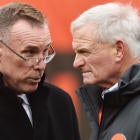
The Browns' Jimmy Haslam era has reportedly been rife with insane back-room controversies
An explosive story detailed all the crazy things that happened with the Browns in recent years

By
Jared Dubin
•
9 min read
The Cleveland Browns' season ended a while ago. They finished 7-8-1, their best record since 2007, which was the last time they made the playoffs. As we all know, the Browns had been pretty terrible in recent seasons prior to breaking out behind Baker Mayfield, Nick Chubb, Myles Garrett, and Denzel Ward. Owner Jimmy Haslam bought the team midway through the 2012 season, and the team had won, four, seven, three, one, and zero games in the years since then before finally getting to 7-8-1 this year.
But as bad as things were on the field -- and they were really, really bad -- they were apparently even more of a mess behind the scenes. ESPN.com's Seth Wickersham came out with an explosive story on Thursday detailing a whole bunch of wild things that have happened during the Haslam era. You've likely already heard about how the Browns accidentally streamed porn on a wall in their facility while trying to conduct market research, but that was only like the 10th craziest thing that happened in Cleveland.
Well, here are just a few more.
Let's begin in 2014, with the firing of former personnel honchos Joe Banner and Michael Lombardi. (Unless otherwise noted, each excerpted paragraph below is as reported by Wickersham.)
In early February 2014, during draft preparation, Banner and Lombardi argued over a player. Haslam called assistant GM Ray Farmer to ask about it. Farmer later told associates he was surprised Haslam knew such specific details about a routine draft meeting. Farmer, who declined comment for this story, told his boss that while everyone knew Banner and Lombardi disliked working together, arguments over draft prospects were common and healthy. Haslam said it made sense and told Farmer he understood. Only in retrospect, Farmer later told staffers, did he realize that Haslam had an ulterior motive for his call.
Haslam next called Banner and asked if the two of them could grab dinner on Feb. 10. That day, Haslam asked to meet at the office before dinner. Haslam and Banner chatted in Banner's office for half an hour about free agency. Banner said he was hungry and asked if they could continue the conversation at the restaurant. Haslam replied by praising Banner for building a strong team.
It was so strong, in fact, that he said he was going to let him go.
Banner was stunned. He asked for a reason. Haslam wouldn't give one, allowing only that Lombardi would be fired too and that he wouldn't change his mind.
A couple months later the Browns owned the No. 4 and No. 26 picks in the NFL Draft. They famously traded down out of the No. 4 slot, where the Buffalo Bills moved up from No. 9 in order to select wide receiver Sammy Watkins. The Browns then moved up from No. 9 to No. 8 and picked Oklahoma State corner Justin Gilbert. The picks ticked on by and Johnny Manziel kept falling further and further down the draft board, and the Browns eventually traded up from No. 26 to No. 22 to select him. Here's how that entire process went down.
In 2014, the war room was packed with Haslam's guests. It was a consequential draft. The Browns were looking to pick a quarterback, either Blake Bortles or Johnny Manziel in the first round, or Teddy Bridgewater or Derek Carr in the second. Farmer was running his first draft. He had a lot to work with: 10 total picks, including an extra first-rounder because of the Richardson trade.
He started the draft by trading down, from No. 4 to No. 9, then traded up to No. 8 to pick Pettine's preferred player, Oklahoma State cornerback Justin Gilbert. With the second first-round pick, Farmer was targeting Oregon State receiver Brandin Cooks. But then Manziel started to slide and Haslam wanted Manziel. Some of the football guys in the room wanted to wait and pick Bridgewater in the second round. But the team had soured on Bridgewater after his interview dinner and workout with team brass; something about Bridgewater's handshake rubbed Haslam the wrong way, he told team executives. Manziel texted Browns quarterbacks coach Dowell Loggains during the draft, begging the team to pick him, and Loggains forwarded the texts to Haslam. Farmer knew whom the owner wanted, so he made a decision that felt like a concession and traded up to draft him, despite significant concerns about Manziel's skill set and hard partying at Texas A&M. Haslam celebrated, but those in the room could tell Farmer was frustrated. After months of planning, he'd given away his two first-rounders to his coach and owner.
The Farmer mentioned there is ex-Browns GM Ray Farmer, who was the assistant GM under the previous regime and apparently was promoted to general manager despite never having interviewed for the job. Farmer is perhaps best known for being suspended by the league for texting coaches on the sideline during games. He was also famously extremely resistant to including analytics in the team's decision-making process, which culminated in the following:
In late rounds of the 2015 draft, if a player was rated with a green dot -- the highest rating -- by the analytics team, Farmer would pass on him out of spite, according to others in the room. He and Pettine, who once had a good working relationship, were barely talking and their staffs could agree on only one thing: They hated the quants who seemed to have Haslam's ear. One night toward the end of the 2015 season, Haslam invited the analytics staff to dinner. Scheiner told him to include Farmer. Haslam didn't want to; he knew Farmer wasn't part of the team's future. Still, according to sources, Haslam told Scheiner -- who declined comment -- that he would invite Farmer, but he never did.
When Farmer learned of the dinner the next day, he told Haslam, "Something's gotta give." Haslam asked to meet in a suite before the Browns' season finale against the Steelers. The conversation lasted 15 minutes, and Farmer walked out as the former GM of the Browns. Haslam never gave a reason.
After Farmer was fired and the Browns elevated Sashi Brown and hired former baseball executive Paul DePodesta, they embarked on a coaching search that eventually ended with the hiring of then-Bengals offensive coordinator Hue Jackson, which, if you've been paying attention to the Browns, you know worked out very well. But it turns out that almost none of the Browns' executives even wanted to hire Jackson in the first place. They all wanted Bills coach Sean McDermott, but Haslam unilaterally decided on Jackson instead, over the advice of the executives he had just hired.
After a few rounds of interviews, the brass voted. It was 4-1 in favor of Sean McDermott, the Panthers' defensive coordinator, a coach who had crushed his interview and was known to be open to new ideas.
Haslam voted for Hue Jackson, the former Raiders head coach and then-Bengals offensive coordinator. Jackson was a respected playcaller and teacher, especially with quarterbacks. Haslam told the group he felt Jackson could relate better to players. Jackson knew how hard it was to get a second chance as a head coach, and he was nervous about the rebuilding plan. He would later tell friends the team undersold him on the extremeness of the rebuilding plan, a charge that Browns executives found absurd, given the level of detail shared during the interview process.
DePodesta wrote Haslam an email arguing that the Jackson hire went against many of the characteristics of successful coaches they had discussed. Brown met with Haslam -- there's always a race to be the last one to talk to Haslam before a big decision -- and told him he thought hiring Jackson would be a bad call. "I hear you," Haslam said.
Then Haslam flew to Cincinnati and hired Jackson, who would report directly to ownership.
In 2017, the Browns secured the No. 1 pick in the draft after a 1-15 season. The Browns had previously traded down out of the No. 2 pick, where the Eagles selected Carson Wentz. The Browns were faced with the decision of whether to pass on a quarterback again. Jackson fervently argued in favor of doing just that, then criticized the front office for not getting him a quarterback high in the draft after the 2017 season went so wrong, with the Browns finishing 0-16.
Now there was debate between targeting Texas A&M defensive end Myles Garrett and North Carolina quarterback Mitch Trubisky. Jackson wanted Garrett and one day made his case by taping pictures of Garrett on the glass walls in Haslam's office as a joke. But Jackson wasn't kidding when he later vowed to Haslam that he wouldn't support Trubisky, publicly or privately. The team ended up deciding in favor of Garrett but kept Jackson in the dark about it until shortly before the draft, for reasons unexplained to him.
The Browns went 0-16 in 2017, nearly unthinkable in the salary cap era and much worse than even the architects of the rebuilding plan expected. It broke the building. The front office felt Jackson's poor coaching cost the team wins. Jackson felt he was in an impossible position because the team had shed so much talent, including star cornerback Joe Haden. Against the advice of scouts, Brown had picked receiver Corey Coleman in the first round in 2016; Coleman was released after two years. Against the recommendation of Brown, Jackson started rookie quarterback DeShone Kizer in 2017; when Kizer struggled, Jackson complained that Brown had passed on Patrick Mahomes and Deshaun Watson. It enraged the front office, given Jackson's insistence on drafting Garrett that year.
Despite that controversy, Jackson kept his spot as the head coach heading into the 2018 season, even though Haslam fired Sashi Brown and replaced him with former Chiefs executive John Dorsey. The Browns selected Mayfield at No. 1 and Ward at No. 4, and picked up Chubb in the second round. Things were looking up, talent-wise. But the Browns were on Hard Knocks, and we all know that training camp was an absolute mess. But even the show managed to miss some things, like this:
During camp last summer, Haslam brought in a friend named Bill Hybels to speak about leadership. Hybels was a Chicago-area pastor who had resigned from Willow Creek Community Church in April. He had been the subject of claims of inappropriate workplace behavior with women; he denied the allegations. Browns staffers were in disbelief that Hybels -- who couldn't be reached for comment -- was now advising the team, especially after Browns employees had sat through a daylong league-mandated annual sexual harassment meeting earlier in the year.
When the Jackson-led team got off to a poor start to the season, Haslam resisted firing him -- at first. He even gave Jackson a dreaded "vote of confidence" prior to the team's Week 8 game against the Steelers. But after the Browns lost that game 37-21, Haslam decided he'd had enough and it was time for Jackson (and offensive coordinator Todd Haley) to go. Jackson did not go quietly into that good night.
So according to people briefed on the meeting, on Oct. 29, Haslam and general manager John Dorsey entered Jackson's office and told him the team was going to move in a different direction.
Jackson asked why he was being fired.
The team quit on you, Dorsey replied.
At the time, four of the eight Browns games had gone to overtime.
"Get the f--- out of my office," Jackson said.
And that, ladies and gentlemen, is the Cleveland Browns.